
 EN
 DE

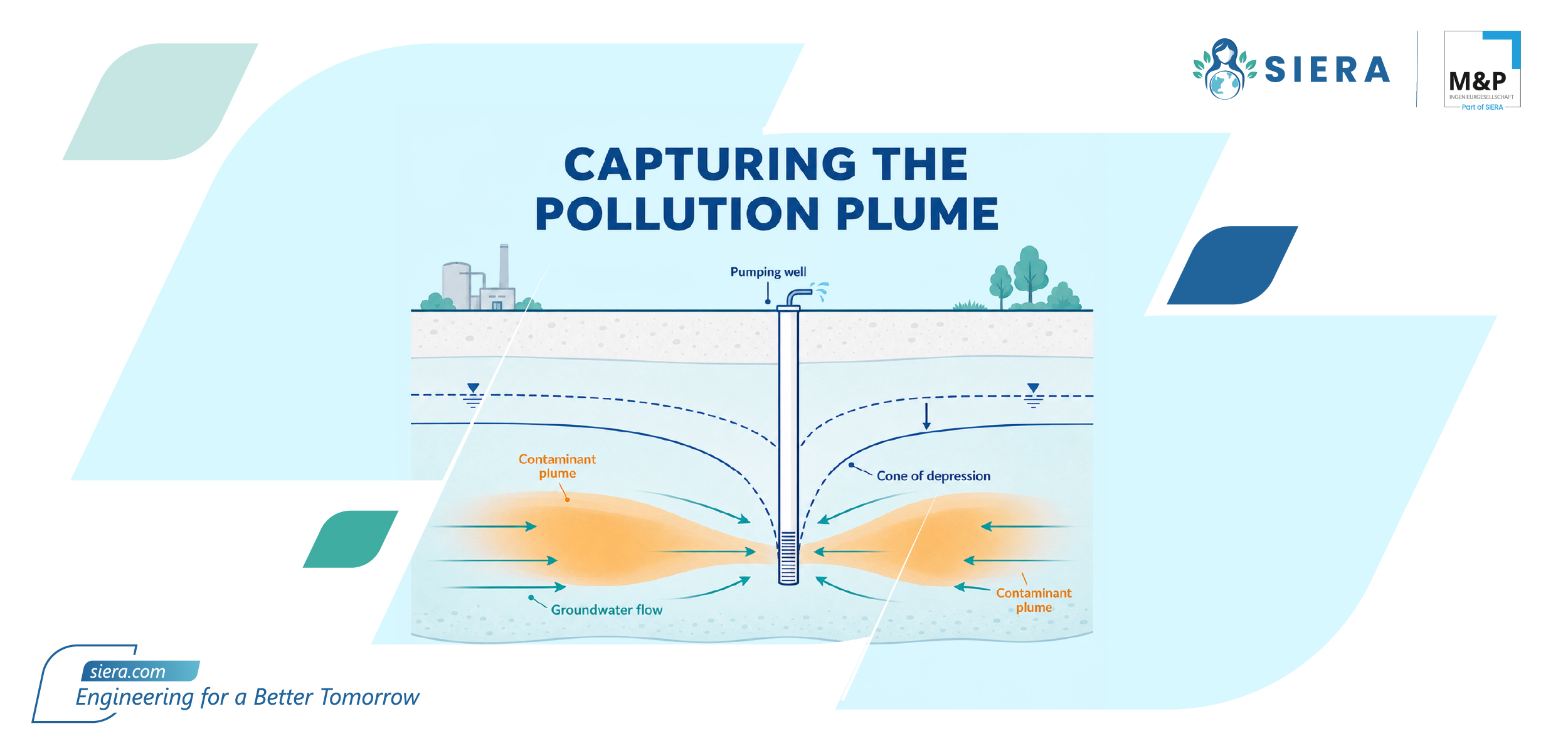
How can a plume of pollutants be reliably detected?
If contaminants are detected in the groundwater, their spread is a key consideration in remediation planning. Where is the contaminant plume located? How does the groundwater move? And what flow rate do extraction wells require in order to hydraulically contain the plume?
To investigate BTEX exposure, M&P Ingenieurgesellschaft Nord – Part of SIERA – a numerical groundwater model was developed and calibrated. The model combines existing measurement data with hydrogeological boundary conditions and information on groundwater recharge. Subsequently, using Particle Tracking investigates the flow rates required for the hydraulic modelling of the simulated pollutant plume.
The results provide a basis for planning the remediation work. At the same time, they demonstrate why model forecasts must always be considered alongside their underlying assumptions and uncertainties.
Measurement data and site conditions form the basis
A groundwater model mathematically simulates flow conditions in the subsurface. To ensure that its results are useful for the specific problem at hand, it must take into account the information available for the site.
For the project under investigation, existing measurement data, hydrogeological boundary conditions and information on groundwater recharge were collated. On this basis, a model was developed that can be used to analyse groundwater flow and the impact of planned extraction wells.
The model was then calibrated: calculated groundwater levels were compared with measured values and the model was adjusted accordingly. This resulted in a very good match. This strengthens the basis for further calculations. However, this does not mean that all the properties of the subsoil or the exact boundary of the contaminant plume are fully known.
Handling incomplete data responsibly
The investigation focused on BTEX contamination. BTEX refers to the substances benzene, toluene, ethylbenzene and xylenes. It was crucial for the planning of the hydraulic containment measures to take the extent of the contamination into account in the model.
It was not possible to fully delineate the plume of pollutants in all directions. Rather than disregarding the unknown areas, a conservative approach was adopted: as a precaution, their assumed extent was expanded.
The modelling therefore takes into account a larger plume than the available data clearly indicates. This step is important for interpreting the results. The calculated coverage refers to the flag expansion assumed in the model – not on a previously demonstrated success in site remediation.
Particle Tracking checks the hydraulic detection
With Particle Tracking Computational flow paths can be traced within the groundwater model. For this project, this was used to investigate whether the planned system of extraction wells would hydraulically capture the modelled contaminant plume and what flow rates would need to be set for this.
The simulations show that, for the base-case scenario under investigation, three extraction wells, each with around 225 m³ Daily output. Taken together, this amounts to approximately 675 m³ per day. Under these model assumptions, the flag in question is fully accounted for.
A model calculation is a planning tool. It assists in the selection and design of a measure, but does not replace the assessment of its impact during subsequent operation.
What happens if an assumption changes?
Hydrogeological parameters are not known with the same degree of certainty throughout the subsurface. For this reason, an additional investigation was carried out to determine how sensitive the result is to changes in hydraulic permeability.
At doubled hydraulic conductivity the calculated required flow rate increases to around 345 m³ per day and per well. For three fountains, this works out at around 1,035 m³ per day. The difference compared with the base-case scenario shows just how much a change in an assumption can influence the interpretation.
| Model assumption under investigation | Number of extraction wells | Calculated flow rate per well | Total calculated flow rate |
| Base-case scenario | 3 | around 225 m³/day | around 675 m³/day |
| Double the hydraulic permeability | 3 | around 345 m³/day | around 1,035 m³/day |
Sensitivity analysis does not provide a second, universally valid funding figure. It shows how the forecast responds to a change in an assumption. For restructuring planning, this information is just as important as the result of the base-case scenario.
Modelling as the basis for refurbishment planning
Numerical groundwater models help to analyse complex flow conditions in a comprehensible manner and to evaluate planned measures before they are implemented. In this project, the model combines four key steps: data analysis, calibration, a precautionary extension of the plume, and the assessment of extraction rates under various assumptions.
For M&P Ingenieurgesellschaft Nord within SIERA The value of modelling does not lie in a single figure. What is crucial is that planning decisions are based on documented data and that uncertainties remain apparent. This makes it easier to assess the requirements placed on hydraulic safety measures.
The results describe the calculated coverage the BTEX plume in the model under investigation. Whether the measure will continue to function as intended under actual conditions must be assessed as part of further planning and during operation.
CTA
Are you planning a groundwater remediation project, or do you need to assess the spread of a contaminant plume? Find out more about @M&P Engineering Company North – Part of @SIERA and discuss how location-based modelling can support your decision-making.
Engineering for a Better Tomorrow