
 EN
EN  DE
DE 
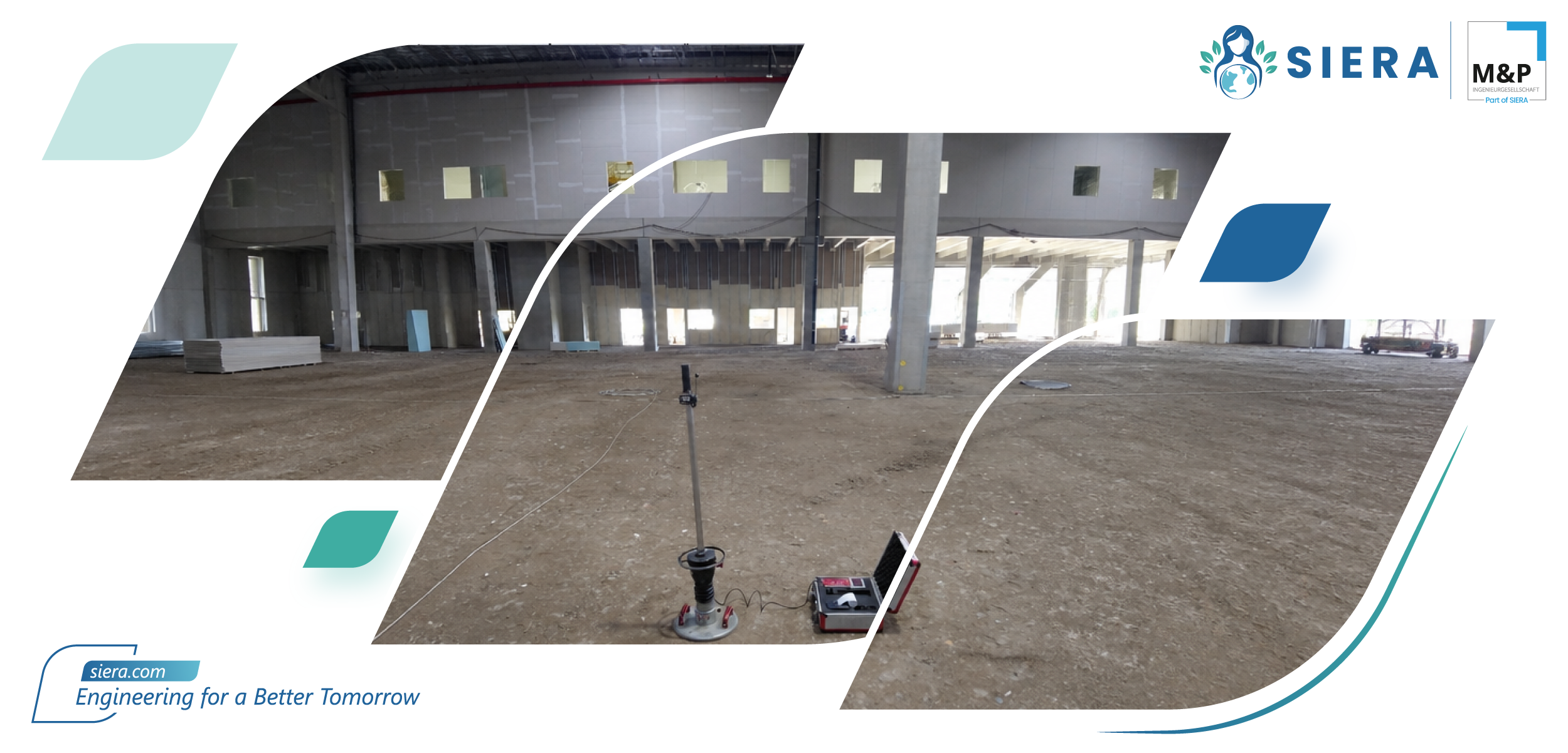
In earthworks, such as the construction of base courses for traffic areas and hall floors, or sub-base layers for foundations, it is crucial that the soil is adequately compacted. This is verified by means of plate load tests and serves as a quality assurance measure in accordance with the ground investigation report and the quality assurance plan. This is carried out by M&P Engineering Firm West about SIERA This topic outlines the key principles for assessing compaction and bearing capacity in earthworks and civil engineering.
Static and dynamic plate compression tests as test methods
Both static and dynamic plate load tests are used. Both methods serve to verify the compaction of the soil and to provide reliable results for assessing its bearing capacity.
Static plate load test in accordance with DIN 18134
The static plate compression test in accordance with DIN 18134 is regarded as legally admissible evidence. The load is applied in several stages up to 0.5 MPa. In this process, Ev1 and Ev2 determined.
An important part of the analysis is the ratio Ev2/Ev1. This ratio indicates further potential for consolidation and is therefore a key criterion for assessing the result.
Dynamic plate load test with determination of Evd
The dynamic plate load test is quick and flexible to use, for example in confined spaces.
The measurement is carried out using repeated falling-weight impacts. The result is Evd. As a rule of thumb, Evd × 2 approximately Ev2 corresponds to.
A simplified overview of the examination procedure
The procedure is clearly structured. A load plate with a diameter of 30 cm is placed on the prepared surface. The load or impact forces are then applied. The settlements are subsequently measured and analysed.
The key steps are:
• Placing the load plate
• Application of the load or impulses
• Measuring settlement
• Analysing the results
Important information regarding the implementation
Careful preparation of the test area is crucial for obtaining meaningful results. The requirements set out in the ground investigation report must also be observed.
If the results are abnormal, the causes must be investigated on site. This ensures that the assessment of compaction and bearing capacity is based on reliable data.
Quality assurance in earthworks and civil engineering
Plate load tests are an important method for assessing compaction and bearing capacity in civil engineering and underground construction. This static test provides Ev1 and Ev2 legally admissible evidence, whilst the dynamic test with Evd is a quick and flexible addition.
Further information on specialist insights and projects can be found at SIERA as well as in the case of M&P Engineering Firm West.
Engineering for a Better Tomorrow.